
Lubbock County Court Calendars Explained
No single daily calendar covers every trial court in Lubbock County. Instead, county pages list judges, coordinators, and reporters, while the local rules explain how cases are assigned and calendars administered. Helpful as those are, neither is a live feed of hearings. The six district courts, three County Courts at Law, four Justice Courts, and the municipal courts each control their own settings. Remember too that a calendar entry is narrower than a docket. It gives you a time and place for one event. The docket captures the fuller run of filings, settings, rulings, and final disposition.
Begin with the exact court named on your notice or case record. Every district court and County Court at Law has separate staff contacts, and each Justice Court keeps its own clerk. A city citation stays with the municipal court that issued it. The Lubbock County courts directory is the right starting point for county trial courts. The local rules cover administration, but for a current date the assigned clerk or coordinator still beats everything else.
Lubbock County Calendar Coverage
With no unified county calendar, the search plan has to change. Never treat a web search result, a payment screen, or an old notice as the last word. Figure out first whether your matter sits in a district court, a County Court at Law, a Justice Court, or a municipal court. Then go to that court directly. County pages post coordinator information for district and county-at-law settings. The precinct clerk holds the docket for JP matters. The public case index may include scheduling details. It does not promise a full daily court calendar.
The split matters because a caption often just says "Lubbock." That could mean the county. It could also mean the City of Lubbock, a JP precinct, or the federal division. The Lubbock County Public Records Portal holds County Clerk and District Clerk indexes after registration. The county says JP coverage is still to come. A Justice Court date therefore means calling the precinct. A municipal setting means the city court. Federal hearings appear on federal calendars, never the county schedule.
Note: A missing online date may reflect a separate court system, not the absence of a pending setting.
Finding Your Court Date
Work every channel, then confirm close to the event. The county index can supply scheduling data for indexed District Clerk and County Clerk matters, and reSearchTX may add statewide context where the court and record category participate. When no public calendar exists, a date has moved, or a JP holds the file, a phone call or counter visit is essential. Ask for the court, case number, proceeding type, courtroom, and whether attendance is remote or in person.
- Read the notice or docket and identify the exact court, case number, and setting type.
- Check the county case index for current scheduling information when a county clerk holds the file.
- Check reSearchTX for a state record, then verify the county and court.
- Call the coordinator, clerk, JP precinct, or municipal court and ask whether the date changed.
- At the courthouse, use the relevant counter or public terminal, then confirm the room and attendance rules.
When you request a date, be specific. Say whether you need a daily docket, a future setting, a hearing notice, or a historical calendar. Give the judge or court, date, case number, event type, jury status, and any remote-access question. Skip the extra sensitive details. A case number is usually a safer locator anyway.
Lubbock County Court Date Checks
Coordinators handle the setting logistics for the district courts, so the assigned coordinator is the practical person to verify a Lubbock County court date that is close, unclear, or recently reset. County pages for the 72nd, 99th, 137th, 140th, 237th, and 364th District Courts list staff, and the County Courts at Law have their own pages and contacts. Use the page for the court named in the docket rather than calling a random division.
Keep your questions focused. Confirm the date, start time, courtroom, judge, setting type, remote or in-person status, and any limit on public attendance. If counsel is involved, contact counsel as well. Coordinators run calendars, but they are not automatically public-information officers and they cannot give legal advice. Under the local rules, a Court Administrator serves as public information officer in consultation with the local administrative judge, so a record request and a setting check may travel different routes.
How to Read a Court Setting
A setting is a scheduled event, nothing more. A trial setting does not prove a trial took place. A disposition date does not mean every related issue wrapped up that day. Always read the setting against later docket entries. A continuance, pass, or reset can replace the first date. The useful calendar fields are the ones tying the event to the right court and case.
| Date | The scheduled day, subject to a later reset, continuance, or cancellation. |
|---|---|
| Time | The docket-call or individual hearing time. Confirm which one applies. |
| Courtroom | The assigned room or hearing location, which may change. |
| Judge or Court | The court responsible for the event, not always the judge who hears it. |
| Setting Type | Arraignment, pretrial, motion, temporary orders, trial, sentencing, or prove-up. |
The case number anchors those fields. Lubbock District Clerk civil numbers can appear as DC-YYYY-CV-XXXX, and family numbers may use DC-YYYY-FM-XXXX. Older cases sometimes carry ten digits or an A suffix with no separators. Keep the format intact, hyphens included, when asking staff to check a setting.
Lubbock County Setting Terms
A setting is a stage, not a verdict. Lubbock County dockets list hearings, trials, and conferences. These appear in criminal, civil, family, probate, eviction, and specialty courts. Reading a future date as a judgment is the classic mistake. The signed order and the full docket tell you how things actually turned out.
- Docket call
- A calendar-management session where cases are called and settings addressed.
- Setting
- A scheduled event that may later be continued, reset, passed, or removed.
- Hearing
- A proceeding on a motion, plea, temporary orders, prove-up, or another issue.
- Trial setting
- A scheduled jury or bench trial date, not proof that trial occurred.
- Disposition
- The recorded outcome, such as judgment, dismissal, plea, or deferred resolution.
The path often reads: filing → setting → hearing → ruling → disposition. Some cases skip or repeat stages. A family matter may have several temporary-order hearings. A criminal case may have arraignment and pretrial dates before plea or trial. An eviction uses the precinct's own docket. Match each label to the exact court and case.
Continuances, Resets, and Cancellations
Courts shuffle dates for plain reasons. A continuance pushes a hearing to a later time. A reset gives it a new date altogether. A cancellation or removal means the event will not happen as first listed, though the case itself usually lives on. The public index may post new scheduling details, but Lubbock County courts do not promise real-time updates everywhere. Read the newest docket entry. Then call the court that owns the calendar. Confirm on the day you plan to travel. Ask if the case is still on the docket, whether the courtroom switched, and whether a remote link is permitted. Keep old and new notices in one place. A signed order may explain the change, so request or inspect it when in doubt. An event that vanishes from a calendar does not mean dismissal. Only a docket entry or court order shows why a setting moved.
Note: Confirm a future setting shortly before appearing because public scheduling information can change without a county-wide live feed.
Lubbock County Hearing Date Access
Watching a Lubbock County hearing from home takes permission, and it depends on the case. The Texas electronic-hearings page explains how Zoom and hybrid proceedings work across the state. That page does not open every Lubbock County court docket event to the public. The presiding judge's instructions and any standing order still control who may watch. So ask the court coordinator first. Confirm whether the hearing is remote, in person, or hybrid. Also check whether observers need approval to join.
The electronic-hearings page is the official state resource on remote proceedings. It also covers the rules that govern them.
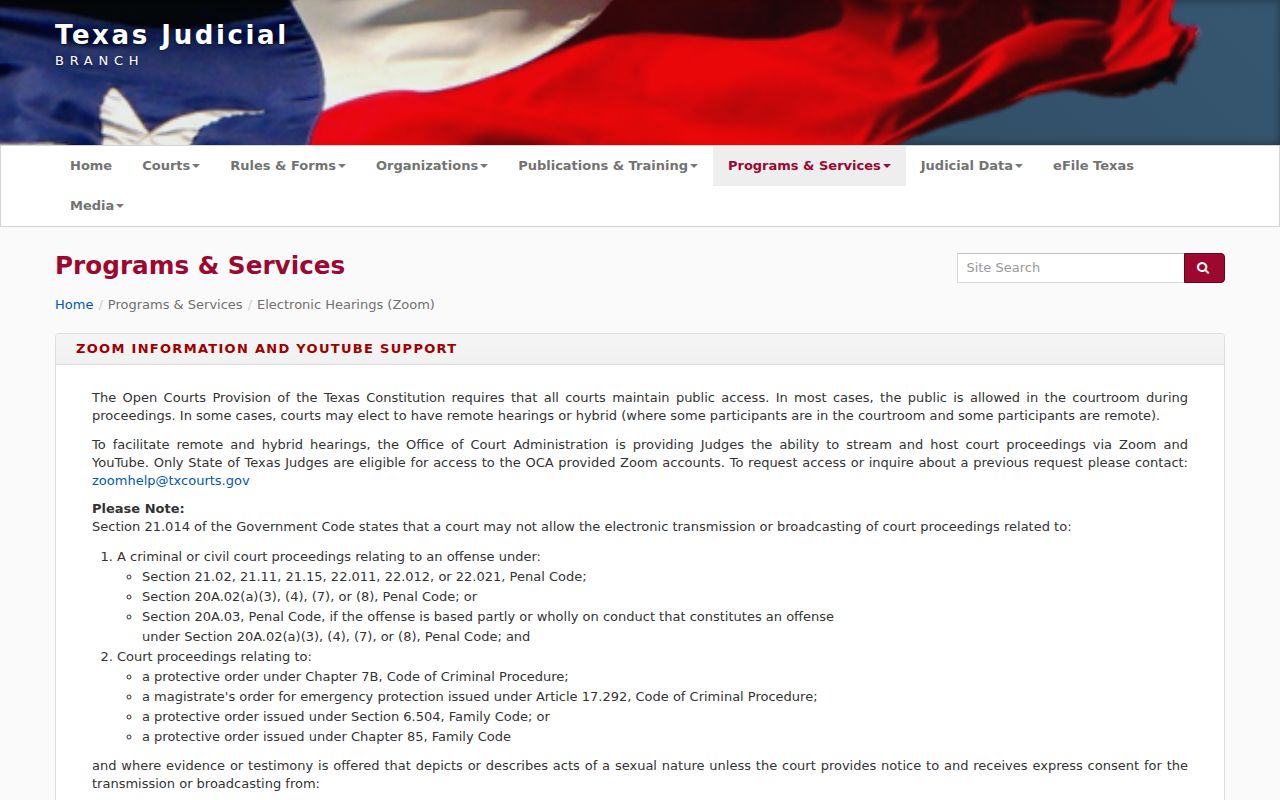
Technology is not the same as an invitation. A court may hold Zoom hearings yet keep each link private. Get the current link and terms from the court itself. A link from an earlier setting should never be reused.
If You Miss a Court Setting
Move fast after a missed setting. Call the clerk or coordinator named on the notice and ask what the docket shows. Have the case number, setting date, and event type ready. If an attorney represents you, call that attorney first. A courtroom or payment portal that carries the Lubbock name may still be the wrong one. Do not use it just for convenience. The right fix depends on the court and the case type. It also depends on anything ordered after you missed the date.
Missed a setting? A missed date can cause serious case-specific consequences, including failure-to-appear action in some matters.
Call the responsible clerk or coordinator now and ask whether a warrant, new setting, order, or other entry exists.
Seek advice from a licensed attorney when rights, bond, custody, or enforcement may be affected.
A calendar entry is only part of the record. Ask the clerk for the latest docket status. Also ask for any filed notice or order showing what comes next. Restricted cases limit what staff may confirm to what law or a court order allows. Write down whom you called, when, and which source you used. Those notes matter when an online docket and a mailed notice disagree.